
Marbach am Neckar, December 9, 2025
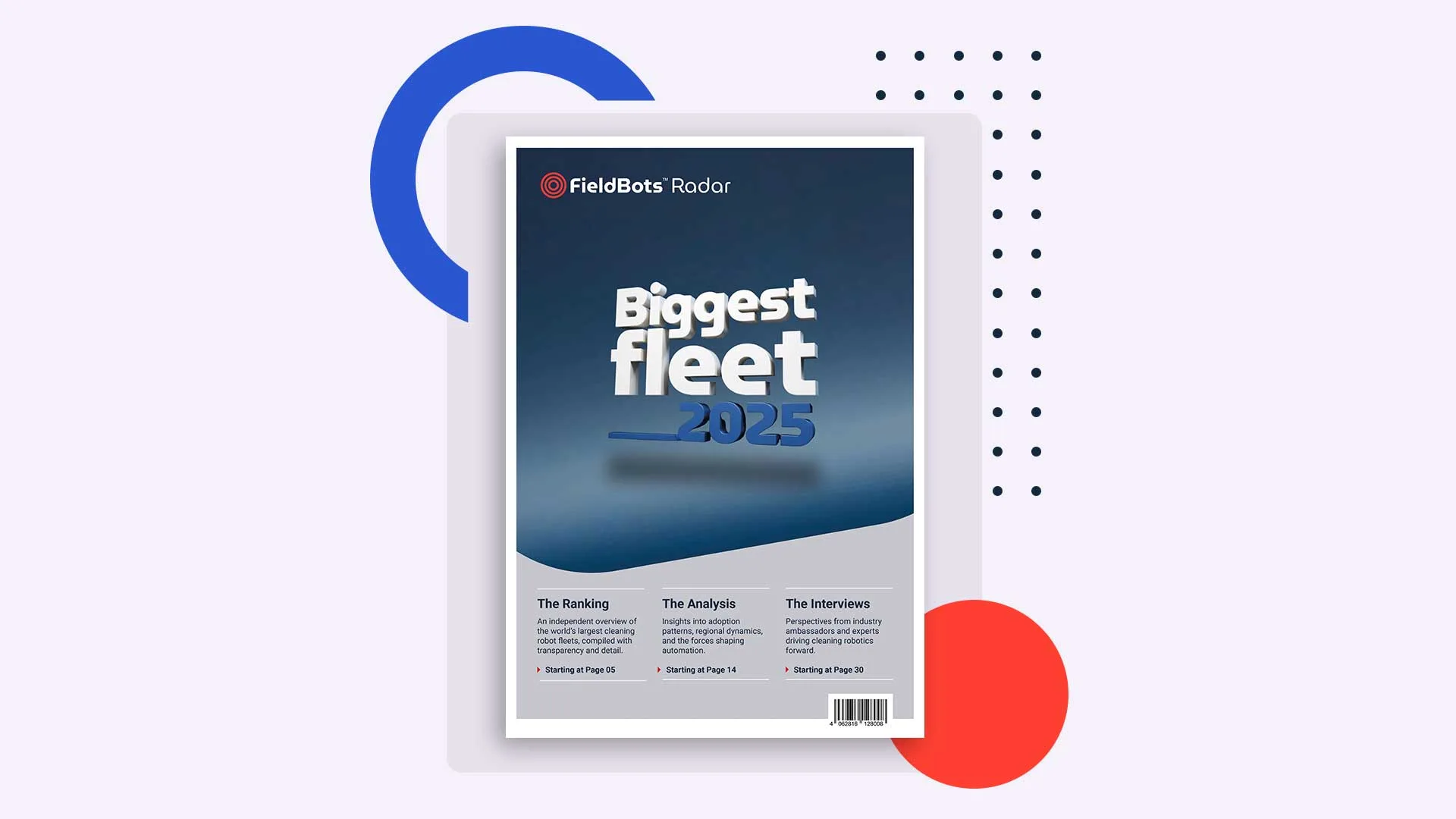
The Biggest Fleet 2025 (https://biggestfleet.com/), the second edition of FieldBots Radar’s independent benchmark of the world’s largest cleaning robot fleets, has been released with 97 participating fleets operating a total of more than 14,000 robots. Compared to the 42 fleets listed in 2024, the dataset has more than doubled, reflecting three forces described in the report: more operators crossing the threshold from pilot projects to genuine fleets, faster approvals as the ranking gains legitimacy, and expanded research capacity combining open applications via biggestfleet.com with direct verification and independent research. The methodology is built around the Radar Score, where all microbots with a purchase price below 10,000 dollars count as one point and standard scrubber robots count as five, creating a common scale across mixed fleets while preserving the underlying investment logic.
Across the 97 valid fleets, the report identifies three “parallel worlds” of deployment: 59 fleets operate robots only, 20 rely exclusively on microbots, and just 18 run mixed combinations of both, 12 of those mixed fleets being managed by cleaning service providers. This confirms the hypothesis that FM service companies are evolving into multi-robot integrators, forced to align different product categories with the operational realities of their client portfolios. At the same time, the market is still relatively shallow: using the Radar Score (robots × 5 plus microbots), 50 of 97 fleets sit at or below 50 points, the equivalent of at most ten scrubbers or fifty microbots. The 2025 story is therefore broad rather than deep-far more entrants, but still only a handful of mega-rollouts.
Retail remains the undisputed engine of global adoption. Walmart holds the number one position with 1,850 verifiable scrubber robots, Sam’s Club (a Walmart division) stays in the Top 5, and Schnucks continues to scale across large-format grocery stores in the United States. Travelodge, with 7,500 RoboVac Buddies supplied by Killis, anchors the hospitality segment at rank two, while European chains such as Denner (200 Pudu robots at rank seven) and ROSSMANN (170 Gausium units at rank nine) demonstrate how discounters and drugstores are now building sizeable fleets of their own. QuikTrip’s debut at rank three with 1,200 Pudu robots is highlighted as a structural break: for the first time, a major U.S. retailer is scaling an Asian OEM at national level, challenging the long-standing Tennant-Brain Corp combination that has dominated many American fleets.
The United States is described as the emerging epicenter of large-scale cleaning robot deployment, with four American operators inside the global Top 5 but only twenty North American fleets in the ranking overall. What sets the U.S. apart is the combination of national decision structures, highly standardized formats and a direct labor-arbitrage business case: once a pilot works, hundreds of machines follow, and the return on investment is straightforward because robots often replace outsourced cleaning services. This view is echoed by Elad Inbar, CEO of RobotLAB and Biggest Fleet ambassador for the Americas, who notes that “for the first time, after so many years in the industry, we now have robots that deliver a clear return on investment,” while businesses at the same time face real labor shortages in roles such as floor cleaning, dish handling or warehouse logistics.
Europe, by contrast, appears both dynamic and cautious. The ranking shows that momentum is tilting east rather than south: B+N Referencia from Hungary enters the global Top 10 at rank eight with 176 self-developed “Robin” robots (Radar Score 880); Albert in the Czech Republic ranks 27th with 40 Tennant scrubbers; MAXI in Serbia appears at 31 with 30 Gausium robots; and Baltic retailers such as IKI in Lithuania and ELVI in Latvia enter at rank 59 with six Gausium units each. Read together, these cases signal a strong openness to automation in Central and Eastern Europe, while no Southern European operator reaches comparable scale in the current dataset. At the same time, the DACH region is carving out a distinct microbot path: Vetter Pharma-Fertigung operates 142 microbots, Vebego Deutschland runs 160 Nexaro units, and additional German and Austrian fleets around Dr. Sasse Gruppe, McDreams, Piepenbrock and other healthcare operators show microbot numbers in the 25-50 range. European ambassador Rainer Kenter, long regarded as an innovation trendsetter in the sector, calls The Biggest Fleet “an excellent tool” for understanding how far robotics has already entered everyday cleaning and explicitly “takes his hat off” to the idea of benchmarking fleets at this level of detail.
Public institutions emerge as a second pillar of growth. According to the analysis, public-sector fleets now reach a combined Radar Score of 1,831, up 145 percent from 747 in 2024, meaning that the sector operates at almost two-and-a-half times last year’s scale. Transportation is the most visible strand: Dubai Airports leads with a score of 150 and Zurich Airport follows with 130, while Shenzhen Metro, Incheon Airport, Chongqing East Railway, Da Nang Airport, Sardar Vallabhbhai Patel International, Pittsburgh International, Queen Alia International and Kelowna Airport all appear with smaller but symbolically important fleets. Education and healthcare add further volume through school districts and university networks in North America as well as hospital and clinic operators in Switzerland and other European countries. These deployments are often built on machines originally developed for retail and general-purpose cleaning, resulting in a deliberately heterogeneous supplier landscape instead of the tight OEM partnerships visible in grocery and convenience retail.
Asia is portrayed as one of the fastest-rising regions. The 2025 edition documents 19 verified Asian fleets with a combined Radar Score of 1,807, built from 296 robots and 327 microbots, almost doubling the region’s presence compared to 2024. Japan leads with a Radar Score of 795, heavily driven by FamilyMart’s 300-unit microbot deployment in convenience stores and additional fleets like Daiei. Singapore contributes 507 points with 96 robots and 27 microbots concentrated in public infrastructure and education, while China accounts for 375 points, almost entirely from 75 larger robots in metro systems, malls and industrial settings. India debuts via Peppermint Robotics, which now operates nine scrubbers across three major airports, and Vietnam enters through Da Nang Airport’s five Gausium robots. At the same time, the report stresses that Asia’s numbers are still conservative, as several sizeable Chinese fleets are suspected but cannot yet be verified. Asia ambassador Lambert Zhang, General Manager of Vortex, underlines this context by describing Asia and China in particular as playing “a critical and unique role in the global robotics landscape,” not only as a manufacturing powerhouse but also as “a major innovation center” that excels at rapid iteration, cost-effective scaling and the integration of advanced AI into practical applications.
Behind the operators, Biggest Fleet 2025 also highlights a fragmented manufacturer landscape. Global equipment brands such as Tennant, Gausium, SoftBank Robotics, ICE Cobotics, Nexaro, Kärcher and Pudu appear side by side with more specialised or regional providers like A&K Robotics, Aoting Bots, CenoBots, Ecovacs Professional, Peppermint and others. No single vendor dominates across all geographies and sectors; instead, fleets often combine multiple suppliers, particularly in European FM portfolios where companies like Götz, Dorfner, Gonder and Werner run heterogeneous mixes of scrubbers and microbots. The report explicitly frames this as both a challenge and an opportunity for facility service providers, who must learn to act as robotics integrators, capable of maintaining multi-OEM fleets while advising customers on suitable product categories rather than isolated machines.
Taken together, the ranking, the sector analyses and the three ambassador interviews position The Biggest Fleet as more than a list: it is a yearly snapshot of how cleaning robotics is scaling, where the bottlenecks remain and which regions are pushing the frontier. For Elad Inbar, the convergence of strong ROI and structural labor shortages means “we need all hands on deck” to accelerate deployment in the Americas. For Rainer Kenter, Europe’s combination of caution and innovation calls for embracing change and using neutral data to cut through hype. For Lambert Zhang, Asia’s trajectory shows that the center of gravity in manufacturing and innovation has moved east, with China “setting the pace for innovation” in both professional and consumer robots. The 2025 edition, with 97 fleets and more than 14,000 robots behind it, is therefore presented not just as a milestone in mapping today’s fleets, but as a starting point for understanding the next wave of global adoption.
FieldBots is the leading platform for managing autonomous cleaning robots, currently supporting eight manufacturers and 23 models. Operators can centrally manage machines from different brands and document cleaning performance. With configurable widgets, automated notifications and integrated ticketing, both operational and technical teams are supported in their daily work.
FieldBots Radar provides free information on FM robotics. This includes statistics from the FieldBots cloud, industry news, product overviews, a directory of relevant manufacturers, as well as the annually published Biggest Fleet Ranking.